Disaster in Toledo. 74 Dead. Three Days of Mourning Declared in Spain
01:39 October 29
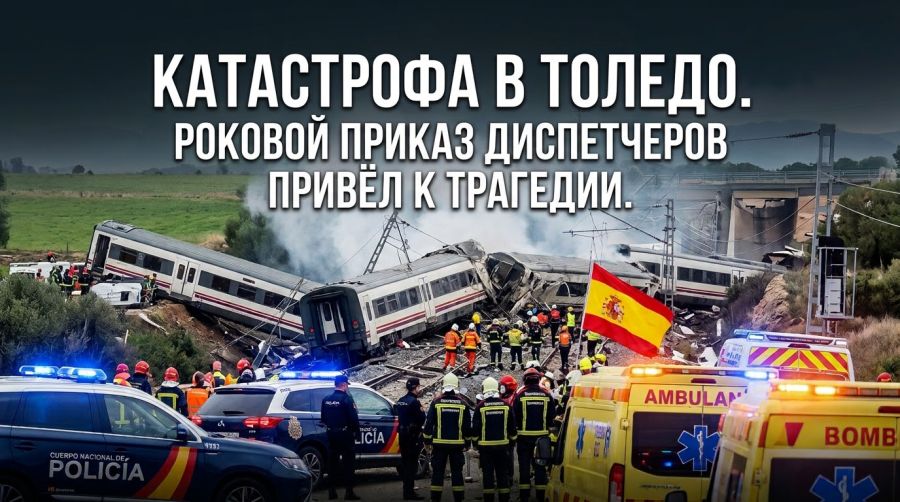
The largest rail disaster has occurred on the Madrid — Andalusia high-speed line in the Spanish province of Toledo (autonomous community of Castile-La Mancha). At least 74 people were killed and over 100 others sustained injuries of varying severity as a result of a collision between two passenger trains. A three-day national mourning has been declared in the country.
Chronology and Details of the Incident
* Time and Place: The accident occurred at approximately 08:53 local time on the section between the municipalities of Los Yébenes and Urda.
* Involved Parties: A high-speed AVE train operated by the state-owned company Renfe crashed at full speed into the rear of a train belonging to private operator Iryo, which had stopped on the tracks.
* Scale: More than 540 people were on board both trains at the time of the crash. The tremendous impact caused the rear two carriages of the Iryo train to derail and fall off the embankment.
* Notable Victims: The death of Fátima Báñez, former Spanish Minister of Employment and Social Security, has been officially confirmed among the deceased.
Causes of the Tragedy: A Chain of Technical and Human Errors
Official statements from the Spanish Ministry of Transport, led by Óscar Puente, and data from the infrastructure manager Adif point to a fatal combination of technical failure and human error.
1. Automation Failure: Due to a loss of communication between three servers at the Urda station, the German LZB computer safety system shut down completely. Electronic traffic control was lost over a 63 km stretch.
2. Emergency Stop: The automatic interlocking system caused all six trains currently in the affected sector to come to a halt, including the Iryo train.
3. The Fatal Order: The control center in Madrid (Atocha station) switched to manual traffic control. Failing to fully grasp the situation and without waiting for the malfunction to be resolved, dispatchers ordered the Renfe train driver to resume travel at normal speed, ignoring the fact that the Iryo train was still stationary on the tracks ahead.
Current Scale of the Disaster in Numbers
Fatalities 74 people
44 casualties on the Iryo train, 24 on the Renfe train. The identification process is ongoing.
Hospitalized 110 people , According to authorities, 60 injured individuals have been discharged, while 15 remain in critical condition.
Total on Board 542 passengers The trains were operating a popular route from Madrid (Atocha) to Seville (Santa Justa).
Rising Tensions and New Investigative Details
* Mass Protests in the Capital: Outraged citizens took to the streets of Madrid, demanding accountability from top railway management. Protests outside the Ministry of Transport escalated into clashes with law enforcement. Against this backdrop, the CSIF union strictly demanded that the government respect the presumption of innocence for dispatchers until all technical assessments are complete.
* Official Confirmation of Former Minister's Death: The Spanish Ministry of Employment has officially confirmed that former minister Fátima Báñez was indeed among the passengers killed in the disaster.
* DNA Collection for Identification: The Spanish Civil Guard issued an urgent appeal to passengers' relatives to provide DNA samples. Due to the severe structural damage to the train carriages and the sheer force of the impact, identifying many of the victims remains extremely difficult.
"Investigators are reconstructing a minute-by-minute timeline based on audio logs obtained by El País. They confirm that the control center in Madrid granted the Renfe train direct clearance to proceed forward, completely ignoring the facts that the automatic safety systems were offline and that the Iryo convoy was stranded on the exact same tracks just 25 kilometers ahead. Switching to manual traffic management effectively triggered the catastrophe."